Station Eleven
Station ElevenStation Eleven is a vast spacecraft at the center of Miranda Carroll’s comic series, a constructed world that carries both the possibility of escape and the cost of exile. Designed to resemble a planet, it travels through deep space without a sun; damaged skies and failing ocean systems have left its inhabitants among islands beneath a permanent twilight. In the story of the comics, that constrained world becomes home, contested territory, and the setting for a longing to return to Earth.
Design and Environment
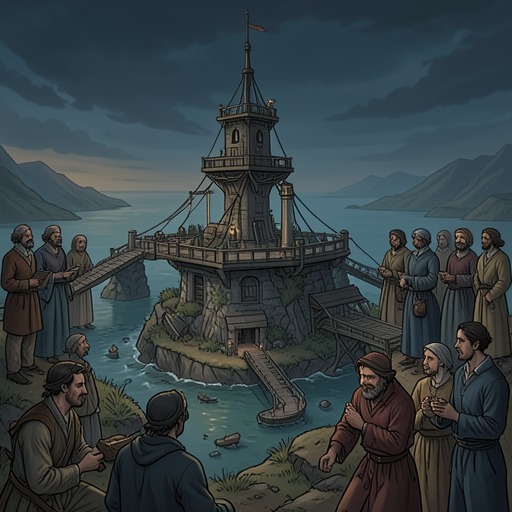
Station Eleven is the size of Earth’s moon, yet was built to look like a small planet. It can chart a course through galaxies and does not require a sun. Its artificial sky was damaged in a war, leaving the surface in sunset, twilight, or night. The station’s ocean levels were also affected by damage to vital systems, so that the remaining land consists of islands that were once mountaintops.
The comics render this environment in vivid detail: deep blue seas, rocky islands linked by bridges, and orange and crimson skies with two moons on the horizon. In one image, Dr. Eleven stands on dark rocks above an indigo sea at twilight, while small boats travel between islands and wind turbines turn on the horizon. He holds his fedora, accompanied by a small white animal named Luli, identified by older readers as a dog unlike any familiar dog. The image condenses the station’s character: an engineered refuge whose beauty is inseparable from damage and displacement.
Escape, Exile, and the Undersea
A hostile civilization from a nearby galaxy has taken control of Earth and enslaved its population. A few hundred rebels steal a spacecraft and escape; Dr. Eleven and his colleagues take Station Eleven through a wormhole and hide in the uncharted reaches of deep space. These events occur a thousand years in the future. The station is therefore not simply a vehicle but the rebels’ means of surviving beyond the power that has conquered their former home.
Life aboard it produces a division. After fifteen years of perpetual twilight, some inhabitants want to return to Earth, seek amnesty, and accept the risks of living under alien rule. They live in the Undersea, an interconnected network of vast fallout shelters beneath the station’s oceans. Their number has grown to three hundred. The opposition between those who remain in hiding and those who wish to go home makes the station a place of political as well as physical refuge: escape has preserved the rebels, but it has not resolved what they owe to the world they left.
One scene in Miranda Carroll’s project places Dr. Eleven in a boat with his mentor, Captain Lonagan, as they pass over an Undersea gate. Dr. Eleven warns that the waters are perilous. The gate gives the station’s hidden division a concrete geography: its open seas and scattered islands sit above a linked world of shelters, where those who want to return to Earth have made their home.
The Comics as a Record of the Station
The surviving account of Station Eleven reaches the post-collapse world through two issues given to Kirsten Raymonde by Arthur Leander: the first, titled Station Eleven, and the second, The Pursuit. By Year Twenty, Kirsten has memorized them. Their expensive production, bright images, and archival paper distinguish them from ordinary mass-produced comics; an older member of the troupe who had worked in printing considers them possibly a private project. Both issues credit their author only by the initials M. C. The first is marked as copy two of ten, the second as copy three of ten, suggesting that very few copies may have been made.
Kirsten has looked after the books, but their edges are dog-eared and worn soft. The first opens to the image of Dr. Eleven above the sea, with Luli beside him. Its caption reads, “I stood looking over my damaged home and tried to forget the sweetness of life on Earth.” The line makes the station’s damaged landscape carry a memory of another home, while the comics themselves become objects preserved through a world in which familiar systems and forms of communication have failed.
A World That Outlasts Its Medium
The station’s imagined islands, twilight skies, and hidden shelters persist in the minds of readers even as the physical technologies of the pre-collapse world become unusable or difficult to recall. Kirsten keeps the comics in memory and in hand; elsewhere, younger people respond to a computer screen with fascination because they have little or no memory of such devices. An inventor’s attempt to power a laptop by pedalling a stationary bicycle briefly raises the hope that the Internet might still exist, but the effort cannot restore the network that once connected distant places.
Station Eleven gives that broken connection a different form. Its inhabitants navigate galaxies, pass through a wormhole, and live in a world engineered to resemble a planet, yet they remain divided by the question of whether to return home. After the collapse, the comics cross a much shorter but equally consequential distance: from Arthur Leander’s gift to Kirsten Raymonde, and from the lost world into the lives of people who can preserve its story. The station thus links technological escape with emotional attachment, presenting survival as more than continued existence: it also depends on what can be remembered, carried, and shared.